
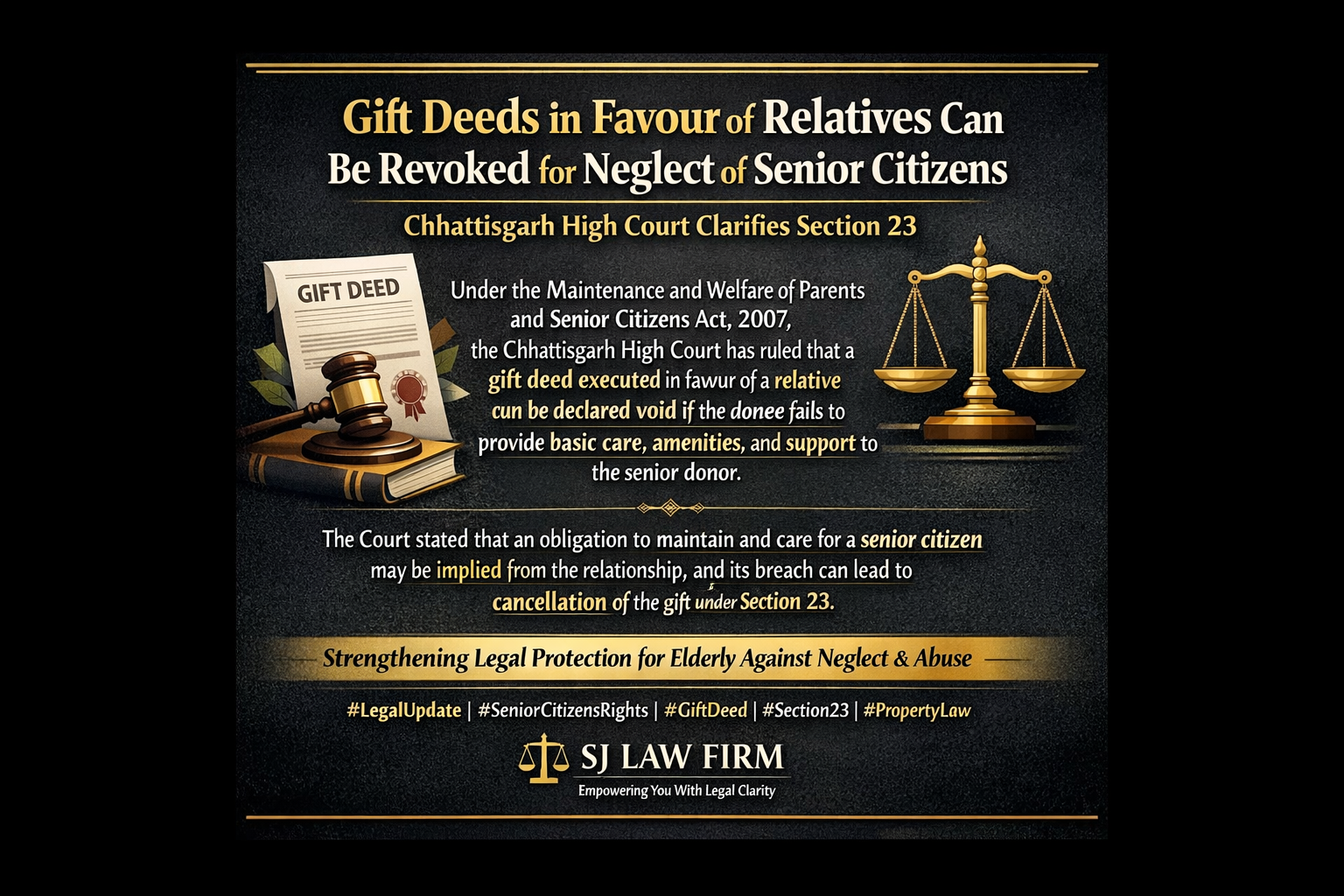
Gift Deeds in Favour of Relatives Can Be Revoked for Neglect of Senior Citizens: Chhattisgarh High Court Clarifies Section 23
Gift Deeds and Senior Citizen Protection Under Indian Law
In a significant interpretation of the Maintenance and Welfare of Parents and Senior Citizens Act, 2007, the Chhattisgarh High Court has reaffirmed the protective scope of Section 23, holding that a gift deed executed by senior citizens in favour of a relative may be cancelled where the transferee fails to maintain and care for the transferors, even in the absence of an express maintenance clause in the deed.
The Court emphasized that transfers of property by elderly persons are often rooted in trust, affection, and the expectation of continued care. Where this foundational expectation is defeated by neglect or ill-treatment, the law permits intervention to safeguard the dignity and welfare of senior citizens.
Factual Background of the Case
The case arose from a registered gift deed executed by senior citizens in favour of a close relative concerning their residential property. Despite the transfer, the senior citizens continued to reside in the property, relying on assurances of care and support. Over time, disputes emerged, with allegations of neglect, harassment, restriction of basic amenities, and denial of access to food, medical assistance, electricity, and visitors. It was further alleged that the elderly transferors were compelled to leave the premises and seek shelter elsewhere.
Invoking Sections 5 and 23 of the 2007 Act, the senior citizens approached the Maintenance Tribunal seeking cancellation of the gift deed and restoration of possession. The Tribunal allowed the application, and the decision was upheld by the Appellate Tribunal.
Legal Issue Before the High Court
The principal issue before the High Court was whether a gift deed could be revoked under Section 23 of the Act when it did not expressly stipulate a condition requiring the transferee to provide maintenance and basic amenities to the senior citizen transferors.
Court’s Analysis and Interpretation
The Single Judge Bench, presided over by Justice Narendra Kumar Vyas, adopted a purposive interpretation of Section 23, underscoring its character as a beneficial provision aimed at preventing neglect and exploitation of elderly persons. Relying on the Supreme Court’s decisions in Sudesh Chhikara v. Ramti Devi and Urmila Dixit v. Sunil Sharan Dixit, the Court reiterated that two conditions must be satisfied to invoke Section 23(1):
-
The transfer must be subject to a condition—express or implied—that the transferee would provide basic amenities and physical needs to the transferor; and
-
The transferee must have failed or refused to fulfil this obligation.
Crucially, the Court clarified that such a condition need not be expressly recorded in the gift deed. It may be inferred from surrounding circumstances, the relationship between the parties, and their subsequent conduct. In the present case, the nature of the transfer, the continued residence of the senior citizens, and the expectation of care established an implied obligation, which was later breached.
Findings and Outcome
The Court held that a rigid or literal interpretation of Section 23 would undermine the legislative intent of protecting senior citizens. It further observed that writ jurisdiction does not permit re-evaluation of factual findings unless they are perverse or without jurisdiction, which was not the case here.
Accordingly, the High Court upheld the concurrent findings of the Maintenance Tribunal and the Appellate Tribunal, affirmed the cancellation of the gift deed, and sustained the directions for eviction of the transferees. The writ petition was dismissed, and interim protection previously granted was vacated.